E-Waste Recycling Machines: Smart Technology for Sustainable Material Recovery
Electronic devices have become an important part of modern life. Computers, smartphones, televisions, printers, networking equipment, household appliances, batteries, and other electronic products eventually reach the end of their useful life. When these products are discarded, they become electronic waste, commonly called e-waste.
E-waste recycling machines are designed to process this material in a controlled and systematic way. Instead of treating discarded electronics as a single waste stream, modern recycling systems can separate different components and materials for further recovery.
A typical e-waste recycling line may include:
- Feeding and conveyor systems
- Dismantling and sorting equipment
- Industrial shredders
- Granulators and crushers
- Magnetic separators
- Eddy-current separators
- Air classification systems
- Optical or sensor-based sorting equipment
- Dust collection systems
- Material recovery and refining equipment
The main objective is to separate useful fractions such as ferrous metals, non-ferrous metals, plastics, circuit-board materials, and other components. Some electronic equipment can also contain valuable metals such as copper, aluminum, gold, and other recoverable materials.
Modern e-waste recycling technology exists because electronic waste can contain both useful resources and potentially hazardous substances. Improper handling can create environmental and health risks, while controlled recycling can support material recovery and circular-economy practices.
Why E-Waste Recycling Machines Matter Today
The volume of electronic waste is increasing as digital equipment becomes more widespread and product lifecycles change. In India, the Central Pollution Control Board reported estimated e-waste generation of 1,397,955.59 tonnes during financial year 2024–25, compared with 1,254,286.55 tonnes in 2023–24. The reported percentage collected, dismantled, recycled, or disposed increased from 61.94% to 70.71% during the same period.
This trend makes efficient electronic waste management increasingly important for manufacturers, recyclers, policymakers, businesses, and households.
E-waste recycling machines can help address several important challenges.
Resource Recovery
Electronic products contain materials that can be recovered and returned to industrial production. Copper, aluminum, iron, plastics, and selected precious metals can be separated through appropriate processing methods.
Recovering these materials can reduce dependence on newly extracted raw materials and support a more circular approach to manufacturing.
Safer Waste Handling
Electronic waste may contain substances such as lead, mercury, cadmium, and other potentially hazardous materials. CPCB guidance notes that improper handling and recovery can create risks because of these substances.
Controlled dismantling, separation, dust management, and material handling can reduce unnecessary exposure and environmental contamination.
Better Material Separation
Manual sorting alone can be slow and inconsistent when processing large quantities of mixed electronic waste. Mechanical and automated separation technologies can improve the consistency of material classification.
For example, magnetic separation can identify ferrous materials, while eddy-current systems can separate certain non-ferrous metals from other fractions.
Support for Circular Economy
A circular economy aims to keep materials in productive use for as long as practical. E-waste recycling contributes to this objective by recovering materials from discarded electronics instead of treating the entire stream as residual waste.
This approach is increasingly relevant to industries working on resource efficiency, sustainable manufacturing, electronic waste management, and critical-material recovery.
Recent Developments in E-Waste Recycling Technology
E-waste recycling has continued to develop during 2025 and 2026, with greater attention on formal recycling infrastructure, material recovery, Extended Producer Responsibility, and critical minerals.
Government data published in July 2025 showed that India had registered recyclers across 19 states. The number of registered recyclers increased in several states between financial years 2023–24 and 2024–25. For example, Gujarat increased from 37 to 41 registered recyclers, Karnataka from 41 to 57, Maharashtra from 50 to 75, and Uttar Pradesh from 74 to 125.
These developments indicate increasing formalization of e-waste processing infrastructure.
Another important trend is the growing focus on recovering valuable and critical materials from electronic waste. Government information published in 2025 highlighted limitations in domestic processing capacity for certain black-mass and critical-mineral recovery activities, while policy discussions focused on strengthening the recycling value chain.
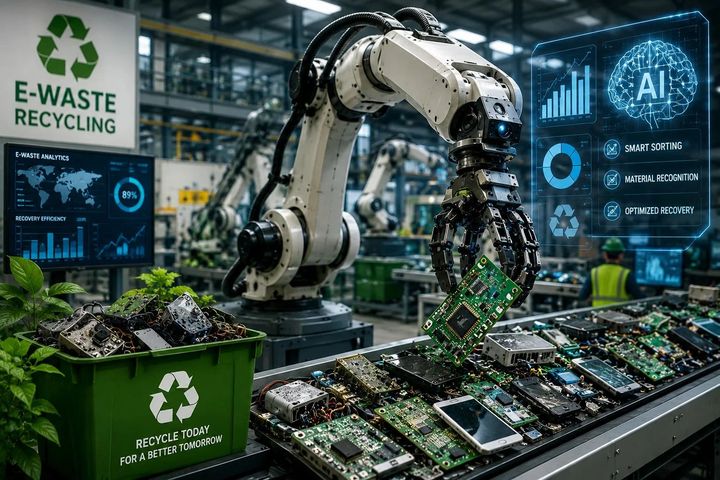
Technology development is also moving toward more precise sorting and automated material identification. Common areas of innovation include:
- Sensor-based material sorting
- Automated dismantling
- Improved shredding systems
- Advanced dust-control technology
- AI-assisted classification
- Better separation of mixed metals
- Improved recovery of critical materials
- Digital monitoring of recycling operations
These technologies are particularly useful when recycling facilities need to handle diverse electronic equipment with different material compositions.
E-Waste Recycling Machine Process
The exact process varies according to the type of electronic waste and the materials targeted for recovery. A general recycling workflow may include several stages.
Collection and Inspection
Discarded electronic equipment is received and inspected. Items may be categorized according to equipment type, condition, material composition, and potential hazards.
Dismantling
Selected components are removed before mechanical processing. Batteries, screens, cables, circuit boards, and other sensitive components may require separate handling.
Shredding
Suitable materials can be reduced into smaller pieces using industrial shredders or size-reduction equipment. Particle size affects the efficiency of subsequent separation stages.
Separation
Different technologies separate materials according to their physical properties.
- Magnetic separation targets ferrous metals.
- Eddy-current separation can separate non-ferrous metals.
- Air classification separates materials according to density and aerodynamic behavior.
- Screening separates particles by size.
- Sensor-based systems can identify selected material categories.
Recovery and Refinement
Separated fractions can undergo additional processing depending on their composition and intended recovery pathway. The objective is to produce cleaner material streams suitable for appropriate downstream processing.
Key Machine Types Used in E-Waste Recycling
| Machine Type | Main Function | Typical Material Focus |
|---|---|---|
| Industrial Shredder | Reduces material size | Mixed electronic waste |
| Granulator | Produces smaller particles | Plastics and metals |
| Magnetic Separator | Removes ferrous metals | Iron and steel |
| Eddy-Current Separator | Separates non-ferrous metals | Aluminum and similar metals |
| Air Classifier | Separates lightweight fractions | Plastics and fine materials |
| Vibratory Screen | Separates by particle size | Mixed processed material |
| Optical Sorter | Identifies selected materials | Plastics and other fractions |
| Dust Collection System | Controls airborne particles | Fine dust and process residues |
Machine selection depends on material type, processing capacity, particle-size requirements, contamination levels, and applicable environmental controls.
Laws and Policies Affecting E-Waste Recycling in India
India's primary framework is the E-Waste (Management) Rules, 2022, notified in November 2022 and effective from 1 April 2023. The framework operates under the Environment (Protection) Act, 1986.
A major feature is Extended Producer Responsibility (EPR). Under the framework, specified manufacturers, producers, refurbishers, and recyclers have registration and compliance responsibilities through the CPCB's EPR system. The rules establish recycling obligations and mechanisms involving EPR certificates.
The framework also includes provisions relating to:
- Registered recyclers
- Recycling targets
- EPR certificates
- Refurbishing certificates
- Environmental compensation
- Reporting requirements
- Audits and verification
- Environmentally sound management
The E-Waste (Management) Rules have also been amended, including amendments issued in 2024. The Ministry of Environment, Forest and Climate Change maintains the relevant rules and amendments.
Recycling facilities therefore need to consider applicable national rules as well as requirements administered by relevant state pollution control authorities.
Tools and Resources for E-Waste Recycling
Professionals and researchers can use several categories of tools when planning or studying electronic waste recycling.
Material Identification Tools
Portable material analyzers, weighing equipment, particle-size measurement tools, and component identification systems can help determine the composition of incoming materials.
Process Monitoring Tools
Digital production monitoring systems can track throughput, equipment performance, material fractions, and operational parameters.
Environmental Monitoring Tools
Facilities may use dust monitoring, air-quality measurement, noise monitoring, and workplace assessment equipment where appropriate.
Planning and Calculation Tools
Useful planning resources include:
- Material-flow calculators
- Recycling-rate calculators
- Capacity planning spreadsheets
- Waste classification templates
- Equipment maintenance schedules
- Environmental compliance checklists
- EPR reporting templates
- Inventory tracking worksheets
Official regulatory portals and government publications should be checked for the latest compliance requirements because waste-management rules and reporting procedures can change.
Frequently Asked Questions
What are e-waste recycling machines?
E-waste recycling machines are industrial systems used to dismantle, reduce, separate, sort, and process discarded electronic equipment. Different machines perform different stages of material recovery.
Which materials can be recovered from e-waste?
Depending on the equipment and processing method, recoverable materials can include iron, steel, copper, aluminum, plastics, circuit-board fractions, and selected precious or critical metals.
Why is e-waste recycling important?
It helps manage increasing volumes of discarded electronics, recover useful materials, reduce the amount of waste requiring final disposal, and support more responsible resource management.
Are e-waste recycling machines suitable for all electronic waste?
No. Different electronic products contain different materials and components. Batteries, screens, circuit boards, appliances, and small electronic devices may require different handling and processing methods.
What rules apply to e-waste recycling in India?
The E-Waste (Management) Rules, 2022 are the main national framework. They include Extended Producer Responsibility requirements, registration provisions, recycling obligations, reporting, verification, and environmental compliance measures.
Conclusion
E-waste recycling machines are becoming increasingly important as electronic waste volumes grow and industries place greater emphasis on resource efficiency. Shredders, granulators, magnetic separators, eddy-current separators, screens, air classifiers, and advanced sorting technologies can work together to separate useful material fractions.