Green Hydrogen Storage Guide: Technologies, Benefits & Future Trends
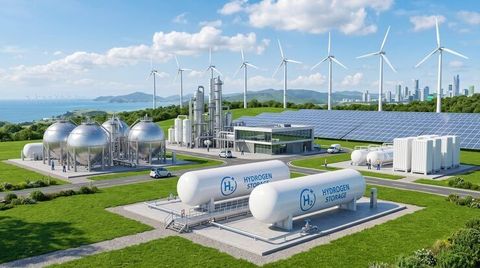
Green hydrogen is hydrogen produced by splitting water into hydrogen and oxygen using electricity from renewable sources such as solar and wind. Because renewable electricity can vary throughout the day, hydrogen storage can help separate production from later use.
Green hydrogen storage refers to the methods used to retain hydrogen safely after production and before it is transported, converted, or consumed. Storage can take place in compressed gaseous form, as a cryogenic liquid, or through chemical and material-based approaches.
The need for hydrogen storage exists because hydrogen production and hydrogen demand do not always occur at the same time. Solar power, for example, produces electricity mainly during daylight hours, while industrial facilities may need energy continuously.
A storage system can therefore become an important link between renewable power generation, hydrogen production, transportation, and end-use applications.
Common storage approaches include:
- Compressed hydrogen storage: Hydrogen is stored as a high-pressure gas in specially designed tanks or cylinders.
- Liquid hydrogen storage: Hydrogen is cooled to extremely low temperatures until it becomes a liquid.
- Underground hydrogen storage: Large quantities can potentially be stored in suitable geological formations, including salt caverns.
- Chemical carriers: Hydrogen can be converted into substances such as ammonia or liquid organic hydrogen carriers for transportation and later use.
- Solid-state storage: Certain materials can absorb or bind hydrogen and release it when required.
Each approach has different requirements involving pressure, temperature, materials, infrastructure, safety, and intended application.
Why Green Hydrogen Storage Matters Today
Green hydrogen storage matters because renewable energy systems increasingly require ways to manage variable electricity generation. Hydrogen can act as an energy carrier that connects renewable electricity with industrial and transportation applications.
For industries such as steel, chemicals, refining, shipping, and heavy transport, hydrogen storage can support a more flexible supply chain.
Storage can also help with energy balancing. When renewable electricity production is high, surplus electricity can be used for electrolysis and the resulting hydrogen can be stored. When hydrogen demand increases, the stored gas can be supplied to the appropriate application.
The technology can address several energy-system challenges:
- Managing fluctuations in renewable electricity.
- Supporting continuous industrial hydrogen demand.
- Connecting production sites with distant users.
- Creating flexibility in hydrogen infrastructure.
- Supporting large-scale clean energy projects.
- Enabling hydrogen derivatives such as green ammonia.
- Providing longer-duration energy storage options.
The International Energy Agency reported in its Global Hydrogen Review 2026 that global hydrogen demand exceeded 100 million tonnes in 2025. Low-emissions hydrogen production reached almost 1 million tonnes, while installed electrolysis capacity more than doubled during 2025 to exceed 4 GW.
These developments highlight why hydrogen storage infrastructure is becoming an important consideration as hydrogen production expands.
Comparing Major Storage Approaches
| Storage method | Main characteristic | Typical consideration |
|---|---|---|
| Compressed gas | Hydrogen remains gaseous | High-pressure equipment |
| Liquid hydrogen | Hydrogen is stored at cryogenic temperature | Very low-temperature systems |
| Salt cavern storage | Large underground storage potential | Suitable geology required |
| Ammonia carrier | Hydrogen is transported chemically | Conversion and reconversion |
| Solid-state storage | Hydrogen interacts with storage materials | Material performance and weight |
The best approach depends on the required storage duration, quantity, location, transportation method, and final application.
Recent Developments and Future Trends
The hydrogen sector has continued to develop during 2025 and 2026, although infrastructure and project execution remain important challenges.
The IEA's Global Hydrogen Review 2026, published on June 18, 2026, reported that announced underground hydrogen storage projects could provide approximately 11 TWh of capacity by 2035, equivalent to about 335 kilotonnes of hydrogen. However, only a small portion of these projects had reached final investment decisions or construction.
This indicates that underground storage has significant potential but remains an emerging part of the global hydrogen infrastructure.
Another trend is the development of hydrogen carriers. Ammonia is receiving considerable attention because it can be handled through infrastructure already associated with ammonia trade in some regions. The IEA reported that around 170 ammonia and 130 methanol port terminals were operating globally, while additional infrastructure was being developed.
India is also strengthening its green hydrogen ecosystem. The Ministry of New and Renewable Energy updated guidelines for Hydrogen Valley Innovation Clusters and Green Hydrogen Hubs on June 27, 2025. The National Green Hydrogen Mission also identifies hydrogen storage technologies among its pilot-project areas.
In March 2026, the Ministry issued a call for proposals related to skilling, upskilling, and reskilling under the National Green Hydrogen Mission. This reflects the growing need for technical knowledge across the hydrogen value chain.
Future development is likely to focus on improved storage materials, larger underground systems, better compression equipment, hydrogen carriers, monitoring technologies, and integration with renewable energy projects.
Laws, Policies, and Safety Frameworks in India
In India, green hydrogen development is supported by the National Green Hydrogen Mission. Its objective is to establish India as a global hub for green hydrogen production, use, and export while supporting decarbonization and reducing dependence on fossil fuel imports. The mission specifically recognizes the importance of pipelines, tankers, intermediate storage facilities, and distribution networks.
Safety is particularly important because hydrogen has different physical characteristics from conventional fuels. Storage facilities need appropriate controls for pressure, ventilation, leak detection, isolation, materials, and emergency response.
India's National Green Hydrogen Mission portal maintains a dedicated collection of standards covering hydrogen production, storage and transportation, end-use applications, and general safety. The listed standards include requirements for hydrogen storage systems, cylinders, process piping, vent systems, cryogenic vessels, and related equipment.
A June 2025 amendment under India's petroleum and explosives safety framework introduced definitions and provisions relevant to hydrogen storage systems and liquefied hydrogen. It also references recognized technical standards for hydrogen-related systems.
For compressed hydrogen installations, safety provisions can include appropriate ventilation, separation distances, pressure controls, venting arrangements, isolation valves, and equipment designed for the specified working pressure.
Organizations developing hydrogen storage projects should therefore assess the applicable Indian standards, approvals, environmental requirements, fire-safety provisions, pressure-vessel requirements, and site-specific regulations before implementation.
Tools and Resources for Understanding Hydrogen Storage
Several types of resources can help students, engineers, researchers, policymakers, and energy planners understand green hydrogen storage.
Hydrogen production and storage calculators can help estimate hydrogen quantities, pressure requirements, energy use, and storage duration.
Renewable energy modeling tools can compare solar and wind generation profiles with hydrogen production and storage requirements.
Hydrogen infrastructure databases can provide information about production facilities, pipelines, storage projects, and announced developments.
Safety standards databases can help users identify technical requirements for cylinders, pressure vessels, piping, ventilation, leak detection, and hydrogen handling.
Material-selection references can help explain hydrogen compatibility, embrittlement, temperature performance, and pressure-related considerations.
Energy-system simulation platforms can model renewable electricity, electrolysis, hydrogen storage, and industrial demand together.
For India-focused research, the National Green Hydrogen Mission portal provides information about regulations and standards, while the IEA Hydrogen Tracker provides international project and infrastructure data.
Frequently Asked Questions
What is green hydrogen storage?
Green hydrogen storage is the process of retaining hydrogen produced using renewable electricity so it can be used later. Storage may involve compressed gas, liquid hydrogen, underground formations, chemical carriers, or specialized materials.
Which hydrogen storage method is most common?
Compressed gaseous hydrogen is widely used for applications requiring relatively accessible storage and distribution. Liquid hydrogen and underground storage become more relevant for particular applications involving transportation, high volumes, or longer-duration storage.
Why is hydrogen storage important for renewable energy?
Renewable electricity generation can vary depending on sunlight and wind conditions. Hydrogen storage can help shift energy availability from periods of high renewable generation to periods when hydrogen or energy is needed.
Is underground hydrogen storage possible?
Yes. Salt caverns and other suitable geological formations are being investigated and developed for large-scale hydrogen storage. However, geological suitability, safety, hydrogen purity, infrastructure, and project economics must be evaluated carefully. The IEA identifies underground storage as an emerging area with significant announced capacity.
What are the main safety concerns with hydrogen storage?
Important concerns include hydrogen leakage, high pressure, fire risk, material compatibility, ventilation, temperature control for liquid hydrogen, and appropriate emergency isolation. Storage systems should follow applicable technical standards and safety requirements.
Conclusion
Green hydrogen storage is an important component of the developing hydrogen economy. It helps connect renewable electricity production with industrial demand, transportation, energy infrastructure, and hydrogen derivatives.