Industrial Food Processing Equipment: Advanced Machinery and Global Manufacturing Trends
Food manufacturing plays an important role in supplying packaged, processed, and prepared foods to consumers worldwide. Industrial food manufacturing equipment supports the transformation of raw ingredients into finished products through organized production processes.
Modern food factories use different types of industrial food processing machinery to handle cleaning, cutting, mixing, cooking, cooling, and packaging. These machines help manufacturers maintain consistent production conditions while managing large quantities of ingredients.
Industrial equipment is used across many food categories, including bakery products, dairy items, beverages, frozen foods, snacks, and prepared meals. Each category requires machinery designed for specific ingredients, processing temperatures, production speeds, and hygiene requirements.
As food demand and manufacturing methods continue to change, equipment technology is becoming more connected, automated, and resource-efficient. Understanding these developments helps explain how modern food production systems operate.
Importance
Supporting Large-Scale Food Production
Industrial food manufacturing equipment allows factories to process ingredients in organized stages. Instead of relying entirely on manual operations, manufacturers can use machinery to perform repetitive tasks with controlled settings.
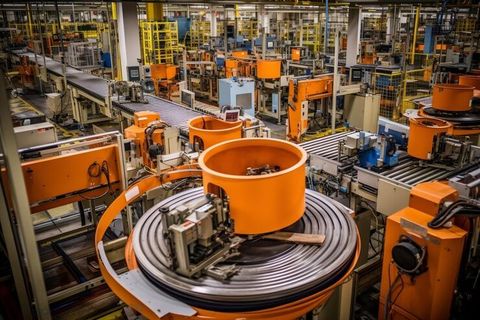
Food production line equipment connects different processing stages into a continuous or semi-continuous workflow. This arrangement helps factories coordinate ingredient preparation, processing, inspection, and packaging.
Improving Consistency and Quality
Food products need consistent characteristics such as texture, appearance, moisture, and size. Industrial machinery helps maintain these characteristics by controlling processing conditions.
For example, temperature-controlled cooking systems can maintain defined heating conditions, while automated mixing equipment supports uniform ingredient distribution. These functions are important in producing similar batches under established manufacturing procedures.
Maintaining Hygiene and Food Safety
Food processing plant machinery must be designed with suitable hygiene considerations. Equipment surfaces, cleaning access, drainage, and material selection can influence how easily production areas are maintained.
Many food facilities use stainless steel equipment, hygienic fittings, and cleaning systems designed for their specific production requirements. Proper maintenance and sanitation procedures remain essential regardless of automation level.
Industrial Food Processing Machinery
Common Equipment Types
Different machines perform different functions throughout food manufacturing. Their selection depends on the product, ingredient properties, production volume, and factory layout.
Common equipment categories include:
Preparation equipment: Washing machines, peeling systems, cutters, grinders, and sorting units.
Mixing equipment: Industrial mixers, blending tanks, kneaders, and emulsifying systems.
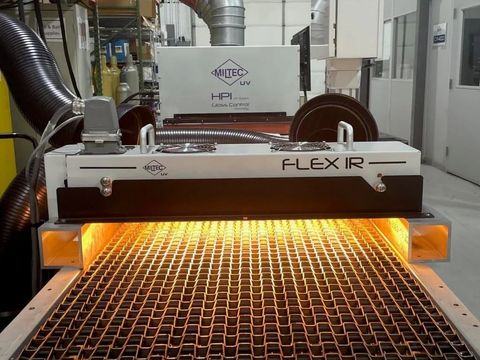
Thermal processing equipment: Ovens, pasteurizers, cookers, boilers, and cooling tunnels.
Separation equipment: Filters, centrifuges, sieves, and screening machines.
Packaging equipment: Filling machines, sealing systems, labeling machines, and wrapping equipment.
These machines may operate independently or form part of a complete commercial food manufacturing system.
Industry-Specific Machinery
Industrial bakery equipment includes dough mixers, proofing chambers, baking ovens, and automated slicing systems. These machines support the production of bread, cakes, biscuits, and other baked foods.
Industrial beverage processing equipment commonly includes water treatment units, blending tanks, pasteurization systems, bottle fillers, and beverage packaging lines. Their design varies according to the beverage type and processing method.
Frozen food manufacturing may require blanching systems, freezing tunnels, conveyors, and temperature-controlled storage equipment. Each application has different operating requirements.
Food Manufacturing Equipment Technology
Automation and Robotics
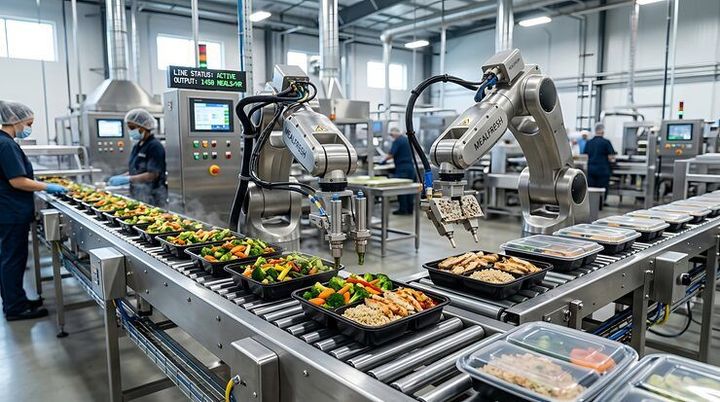
Automatic food processing equipment uses sensors, controllers, and mechanical systems to perform tasks with limited manual intervention. Automation can support activities such as portioning, weighing, sorting, filling, and packaging.
Robotic systems are increasingly used for repetitive handling tasks. Depending on their design, they may move products, arrange packages, or support palletizing operations.
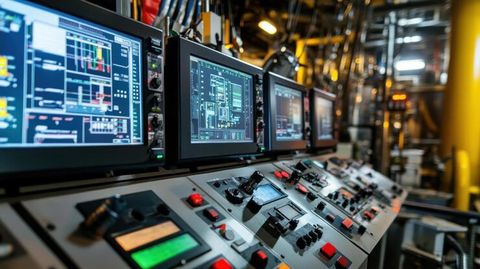
Food factory automation equipment can connect machinery through centralized control systems. Operators can monitor production conditions and adjust settings according to established procedures.
Smart Processing Machinery
Smart food processing machinery uses digital technologies to collect and interpret operating information. Sensors may monitor temperature, pressure, vibration, flow rates, and equipment performance.
This information can help operators identify unusual conditions and plan maintenance activities. Connected systems may also support production tracking and equipment performance analysis.
However, digital monitoring does not replace proper inspection, cleaning, operator training, or food safety controls.
Global Trends
Energy and Resource Efficiency
Food manufacturers are paying attention to energy consumption, water use, and material waste. Equipment designers are developing systems that support more efficient heating, cooling, and processing operations.
Heat recovery systems, variable-speed motors, and improved insulation are examples of technologies used to manage energy requirements. Their practical benefits depend on factory conditions and equipment configuration.
Flexible Production Lines
Manufacturers increasingly need production systems that can handle different product formats and package sizes. Flexible machinery may include adjustable conveyors, programmable controls, and modular processing units.
This approach can help factories adapt production schedules without rebuilding entire manufacturing lines. The level of flexibility depends on product complexity and equipment design.
Sustainable Packaging and Digital Monitoring
Industrial food packaging machines are evolving to support changing packaging materials and production requirements. Manufacturers are exploring packaging formats that reduce unnecessary material while maintaining product protection.
Digital monitoring is also becoming more common in production environments. Data-based systems can help track output, identify process variations, and support quality management.
Equipment Selection and Applications
Selecting food manufacturing machinery requires careful consideration of the production process. Important factors include ingredient characteristics, required output, available space, cleaning procedures, and operating conditions.
Food processing equipment manufacturers and food manufacturing machinery suppliers generally provide equipment designed for specific applications. Buyers and factory planners should examine technical specifications, hygiene design, maintenance requirements, and compatibility with existing systems.
The following table shows how equipment categories are commonly used.
Equipment Category | Main Application |
|---|---|
Preparation machinery | Cleaning, cutting, and ingredient handling |
Mixing systems | Blending and combining ingredients |
Thermal equipment | Cooking, heating, and cooling |
Packaging machines | Filling, sealing, and labeling |
Automation systems | Monitoring and coordinating production |
The most suitable equipment depends on the food product and the manufacturing process rather than one universal machine configuration.
FAQs
What is industrial food manufacturing equipment?
It refers to machinery used to prepare, process, manufacture, and package food products in industrial or commercial facilities.
What are common industrial food processing machinery types?
Common types include mixers, cutters, ovens, pasteurizers, conveyors, filling machines, and packaging systems.
How does food factory automation equipment work?
It uses sensors, controllers, and automated machinery to coordinate production tasks and monitor operating conditions.
What is smart food processing machinery?
Smart machinery uses connected sensors and digital systems to collect operational data and support process monitoring.
What should manufacturers consider when selecting equipment?
They should evaluate product requirements, production capacity, hygiene, energy use, maintenance, and compatibility with the factory layout.
Conclusion
Industrial food manufacturing equipment forms the foundation of modern food production. From ingredient preparation and processing to packaging and quality control, machinery supports organized manufacturing across many food industries.