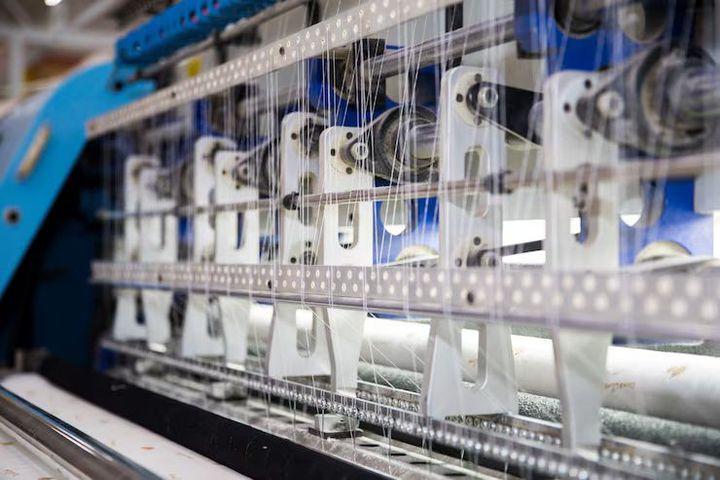
Air Jet Loom Machine Guide : High-Speed Weaving, Automation & Smart Textile Manufacturing
An air jet loom is a shuttleless weaving machine that uses controlled streams of compressed air to carry the weft yarn across the warp shed. Unlike traditional shuttle looms, it does not use a heavy shuttle to insert yarn. This design allows the machine to operate at high speeds while maintaining consistent fabric formation.
Air jet weaving technology developed as textile manufacturers looked for faster and more automated methods of fabric production. Modern systems combine mechanical components with electronic controls, sensors, pneumatic systems, and computerized monitoring.
The basic weaving process involves several coordinated actions:
- Warp preparation: Longitudinal yarns are arranged under controlled tension.
- Shedding: Warp yarns are separated to create an opening.
- Weft insertion: Compressed air carries the weft yarn through the shed.
- Beat-up: The reed pushes the inserted yarn into the fabric structure.
- Take-up: Finished fabric is continuously wound onto a roll.
- Let-off: Warp yarn is gradually released while maintaining suitable tension.
The machine's performance depends on accurate synchronization between these operations. Yarn characteristics, air pressure, nozzle design, loom settings, fabric construction, and environmental conditions can all influence weaving quality.
Air jet looms are particularly relevant to modern textile manufacturing because they can integrate automation and production monitoring into the weaving process.
Why Air Jet Loom Technology Matters Today
Textile manufacturers increasingly focus on productivity, fabric consistency, energy efficiency, and digital manufacturing. These priorities have made advanced weaving machines an important part of industrial automation strategies.
Air jet looms can be suitable for many lightweight and medium-weight woven fabrics. Their high-speed operation can support large-volume production when the machine is correctly configured for the selected yarn and fabric construction.
The technology also helps address several traditional weaving challenges.
Improved Production Monitoring
Modern weaving machines can collect information about operating speed, stoppages, yarn breaks, machine conditions, and production output. Digital monitoring allows production teams to identify recurring problems more quickly.
Greater Automation
Electronic controls can regulate important machine functions. Automated settings reduce the amount of repeated manual adjustment and can improve process consistency.
Fabric Quality Control
Sensors and monitoring systems can identify abnormal machine behavior and production interruptions. Early detection can help prevent repeated defects from continuing through long production runs.
Integration With Smart Manufacturing
Air jet looms can become part of an Industrial IoT environment. Data from multiple machines can be collected in a centralized system for production analysis, maintenance planning, and performance evaluation.
Energy Management
Compressed air is a major part of air jet weaving. Consequently, nozzle efficiency, air pressure, leakage detection, and compressor management are important factors in energy-efficient textile production.
A 2025 industry report noted that global shipments of shuttleless looms declined during 2025, while Asia and Oceania remained the dominant destination for these machines. Air jet loom shipments also declined during the year, showing that textile machinery investment is influenced by broader manufacturing conditions rather than speed alone.
Air Jet Loom Technology at a Glance
| Feature | Description |
|---|---|
| Weft insertion | Compressed air carries weft yarn |
| Machine type | Shuttleless weaving machine |
| Main advantage | High-speed continuous weaving |
| Important input | Compressed air |
| Digital features | Sensors, monitoring, diagnostics |
| Common focus | Productivity, quality, automation |
| Smart manufacturing role | Real-time production data |
Recent Developments in Air Jet Weaving
The past year has seen greater attention toward connected machinery, artificial intelligence, energy management, and predictive maintenance.
In 2025, modern weaving technology was increasingly discussed as part of the wider modernization of India's textile sector. Industry analysis highlighted the need for greater adoption of shuttleless technologies, including air jet and rapier looms, because many existing weaving operations still depend on older equipment.
In May 2026, research presented at the Mechanical and Industrial Engineering Symposium described an IoT-based monitoring approach for an air jet loom. The study explored digital monitoring for machine efficiency and fabric quality using connected data and low-code technology.
The direction of development is also moving beyond simple machine-speed improvements. Current textile engineering discussions emphasize closed-loop tension control, predictive maintenance, energy-aware pneumatic systems, and real-time machine information.
Artificial intelligence is becoming another area of interest. At a 2026 textile manufacturing event in India, industry discussions focused on how AI can provide faster production insights and support decision-making in textile operations.
Energy efficiency is particularly important for air jet technology because compressed air represents a substantial part of the machine's energy demand. Newer systems are therefore focusing on improved air control, leakage identification, optimized nozzles, and intelligent monitoring.
These developments show a broader transition from conventional loom operation toward smart textile manufacturing, where production data becomes part of everyday factory management.
Laws, Standards, and Policies in India
Air jet loom machines used in India are affected by machinery safety requirements, applicable Indian Standards, workplace safety provisions, electrical requirements, and environmental regulations.
The Bureau of Indian Standards published technical guidance in 2025 for weaving machines under India's machinery regulatory framework. The guidance references IS 17361 and ISO-based safety requirements and includes risk assessment considerations for weaving machinery. It also addresses safety-related control-system components and protective measures.
Manufacturers and textile facilities should therefore consider:
- Machine guarding and operator protection
- Emergency stopping arrangements
- Electrical safety
- Pneumatic system safety
- Risk assessment
- Safe maintenance procedures
- Noise and workplace environmental considerations
- Applicable Indian Standards
- Documentation and conformity requirements
India's textile policy environment also supports modernization of the broader textile value chain. The Ministry of Textiles' India Vision 2047 material identifies the PM Mega Integrated Textile Regions and Apparel Parks initiative as a major program supporting integrated textile infrastructure, including weaving and textile manufacturing activities.
Quality Control Orders can also apply to particular textile products. For example, BIS records show that amendments issued in June 2025 changed implementation dates for specified woven textile products such as polypropylene and HDPE woven sacks. These product-specific requirements should not be confused with general requirements for every air jet loom.
Because regulations can change, textile manufacturers should verify the current requirements applicable to their specific machine, product, workplace, and production activity.
Tools and Resources for Air Jet Loom Management
Digital tools can help textile teams understand machine performance and improve production planning.
Useful resources include:
- Production monitoring dashboards: Track loom speed, running time, stoppages, and output.
- Energy monitoring systems: Measure electricity and compressed-air consumption.
- Predictive maintenance software: Analyze machine condition and identify potential maintenance needs.
- Fabric inspection systems: Detect visible defects during or after weaving.
- Yarn calculation tools: Estimate yarn requirements based on fabric construction.
- Maintenance checklists: Record inspections of nozzles, sensors, drives, bearings, and pneumatic components.
- Digital production templates: Organize shift information, machine settings, stoppage reasons, and quality observations.
- Indian Standards databases: Help identify relevant technical and safety standards.
- Industrial IoT platforms: Connect machine sensors with centralized production information.
Practical Performance Indicators
| Indicator | What It Helps Measure |
| Loom utilization | How effectively machine time is used |
| Weft breaks | Stability of weft insertion |
| Warp breaks | Yarn and tension performance |
| Stoppage time | Production interruptions |
| Air consumption | Pneumatic efficiency |
| Fabric defects | Quality performance |
| Maintenance frequency | Equipment condition |
| Output per shift | Production performance |
The most useful approach is not to focus on a single number. Production teams should examine several indicators together because high machine speed does not automatically mean high overall efficiency.
Frequently Asked Questions
What Is an Air Jet Loom Machine?
An air jet loom is a shuttleless weaving machine that uses compressed air to insert weft yarn across the warp. Electronic controls, sensors, and pneumatic components coordinate the weaving process.
How Does an Air Jet Loom Work?
The loom creates a shed by separating warp yarns. A controlled air stream then carries the weft yarn through the opening. The reed beats the yarn into position, and the fabric is continuously taken up.
What Fabrics Can Be Produced on Air Jet Looms?
Air jet looms are commonly associated with lightweight and medium-weight woven fabrics, although suitable fabric types depend on machine configuration, yarn properties, fabric construction, and manufacturer specifications.
Why Is Compressed Air Important?
Compressed air provides the force required for weft insertion. Its pressure, timing, quality, and distribution influence weaving stability. Leakage and inefficient pneumatic settings can reduce overall energy efficiency.
Can Air Jet Looms Be Used in Smart Manufacturing?
Yes. Modern air jet looms can integrate sensors, digital monitoring, production dashboards, and industrial IoT systems. These technologies can provide information about machine performance, stoppages, quality, and maintenance conditions.
Conclusion
Air jet loom machines have become an important technology in high-speed textile weaving because they combine shuttleless weft insertion with automated machine control. Their role is increasingly expanding from simple high-speed production toward connected and data-driven textile manufacturing.