Factory Automation Systems: Modern Assembly Lines & Smart Manufacturing
Factory automation systems use machines, control technologies, software, sensors, and robotics to perform or manage manufacturing activities with limited manual intervention. These systems can support production, assembly, inspection, material handling, packaging, and process monitoring.
Traditional factories often depend heavily on manual operations. Modern manufacturing environments increasingly combine programmable logic controllers, industrial robots, machine vision, sensors, industrial networks, and manufacturing software. Together, these technologies create connected production environments that can collect information and respond to changing conditions.
The purpose of factory automation is not simply to replace human activity. It is also about improving process consistency, workplace safety, production visibility, quality control, and resource management.
A typical automated production environment may include:
- Programmable logic controllers for machine control
- Industrial robots for repetitive movement and assembly
- Sensors for temperature, pressure, position, and condition monitoring
- Machine vision for inspection and measurement
- Human-machine interfaces for operator interaction
- Industrial communication networks for connected equipment
- Manufacturing execution systems for production information
- Data analytics platforms for monitoring and decision-making
Smart manufacturing expands this concept by connecting automation equipment with data systems. This allows manufacturers to understand production conditions in greater detail and identify patterns that may not be visible through manual observation alone.
Why Factory Automation Matters Today
Manufacturing businesses face growing expectations around product quality, production flexibility, workplace safety, energy management, and supply-chain responsiveness. Factory automation systems can address several of these challenges when they are correctly designed and integrated.
One major advantage is consistency. Automated equipment can perform a defined operation according to programmed parameters. This can reduce variations associated with repetitive manual processes.
Automation can also improve production visibility. Sensors and connected machines can continuously generate operational data. Managers and engineers can use this information to monitor equipment status, production rates, downtime, and quality indicators.
Another important area is predictive maintenance. Instead of waiting for equipment failure, maintenance teams can examine vibration, temperature, pressure, current, or operating-cycle information to identify unusual patterns.
Factory automation also affects workplace safety. Robots and automated handling equipment can be used for operations involving repetitive movement, high temperatures, hazardous environments, or heavy materials. Human workers can then focus on supervision, quality decisions, equipment management, and other activities that require judgment.
The technology affects several groups:
- Manufacturers: Improved process visibility and operational control
- Engineers: Better access to machine and production data
- Operators: More structured interaction with production equipment
- Maintenance teams: Improved equipment monitoring
- Quality teams: More consistent inspection and traceability
- Consumers: Greater consistency in manufactured products
Automation is particularly relevant to industries such as automotive manufacturing, electronics, pharmaceuticals, food processing, packaging, chemicals, metalworking, textiles, and industrial equipment production.
Main Technologies Used in Automated Factories
Modern assembly lines combine multiple technologies rather than depending on one machine.
Industrial Robotics
Robots can perform welding, assembly, palletizing, material movement, painting, machine tending, and other repetitive operations. Collaborative robots can work in applications where humans and machines operate in closer proximity, subject to appropriate risk assessment and safeguards.
Programmable Logic Controllers
PLCs are industrial control computers used to monitor inputs and control machines. They are widely used because they can operate continuously in demanding industrial environments.
Machine Vision
Machine vision systems use cameras, lighting, image processing, and software to inspect products. Applications include checking dimensions, identifying defects, reading codes, and verifying assembly conditions.
Industrial Internet of Things
IIoT connects machines, sensors, controllers, and information systems. It provides a foundation for collecting production data and developing connected manufacturing environments.
Digital Twins
A digital twin represents a physical machine, process, or production environment digitally. It can help engineers study performance, simulate changes, and understand potential process improvements before modifying physical equipment.
Artificial Intelligence
AI can analyze large volumes of manufacturing information. Potential applications include quality inspection, anomaly detection, demand analysis, predictive maintenance, and process optimization.
Modern Smart Assembly Lines
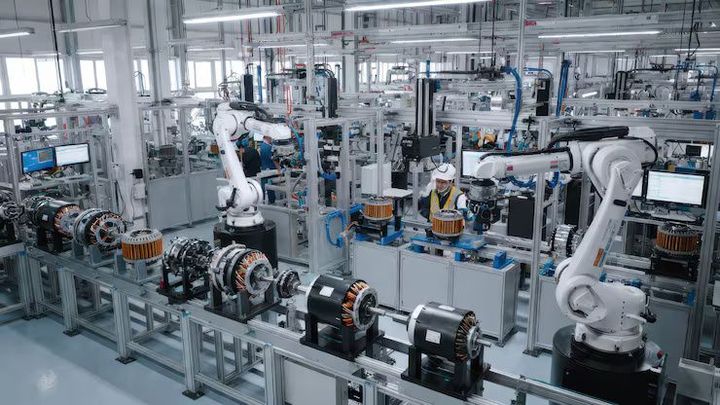
A smart assembly line combines automated equipment, digital controls, connected sensors, and production data.
For example, a product can move through several automated stations. Sensors can verify its position, robots can perform assembly operations, machine vision can inspect the result, and production software can record the process information.
A simplified smart assembly workflow can look like this:
| Stage | Technology | Main Purpose |
|---|---|---|
| Material Input | Sensors and conveyors | Track material movement |
| Assembly | Robots and PLCs | Perform controlled operations |
| Inspection | Machine vision | Detect visible defects |
| Testing | Automated test equipment | Verify product performance |
| Data Collection | Industrial networks | Record production information |
| Monitoring | Manufacturing software | Review production conditions |
The key difference between conventional automation and smart manufacturing is connectivity. An automated machine can perform a task independently, while a smart manufacturing system can connect that activity with broader production information.
Recent Developments in Factory Automation
Factory automation has continued to develop rapidly during 2025 and 2026. Artificial intelligence, robotics, digital twins, industrial data platforms, and advanced manufacturing technologies have received increased attention.
In February 2026, the Indian government held a stakeholder consultation focused on developing an advanced manufacturing strategy. The discussion included manufacturing enterprises, MSMEs, technology developers, academia, research institutions, and other stakeholders.
Also in February 2026, a government-led discussion around AI for Manufacturing Engineering Technology highlighted responsible and scalable AI adoption, skills development, and manufacturing technology.
In October 2025, NITI Aayog presented a roadmap for advanced manufacturing that identified artificial intelligence, machine learning, digital twins, robotics, and advanced materials as important technology enablers across priority manufacturing sectors.
Another notable development was the National Manufacturing Mission announced in the Union Budget 2025–26. Its focus areas include technology availability, quality products, MSME development, and a future-ready workforce.
These developments indicate a broader movement toward connected, data-driven, and technology-enabled manufacturing rather than automation based only on individual machines.
Laws, Safety Standards, and Policies in India
Factory automation must be planned alongside workplace safety, machinery requirements, electrical safety, and applicable industrial regulations.
India's machinery regulatory environment has seen significant changes. The Ministry of Heavy Industries has published amendments and updates relating to the Machinery and Electrical Equipment Safety framework. The regulatory records also show a withdrawal of the 2024 Omnibus Technical Regulation in January 2026 alongside other amendments and related documents.
The Bureau of Indian Standards maintains conformity requirements for machinery and electrical equipment covered by applicable regulations. Relevant machinery safety standards include principles covering risk assessment and risk reduction.
A draft Indian Standard published in 2025 also addressed the integration of machinery into manufacturing systems and incorporated the updated ISO 11161:2025 framework. It included areas such as risk assessment, task-zone design, space requirements, and risk-reduction measures.
Manufacturers and factory operators should therefore review the latest applicable central and state requirements before installing or modifying automated equipment. Requirements can vary according to machinery type, industry, electrical equipment, workplace conditions, and location.
For factories operating in India, safety planning should include:
- Machinery risk assessment
- Emergency stopping arrangements
- Physical guarding where required
- Safe electrical installation
- Operator training
- Maintenance procedures
- Lockout and isolation procedures
- Appropriate protective equipment
- Periodic inspection and documentation
Regulatory requirements should always be checked against the latest government notifications and applicable Indian Standards.
Tools and Resources for Factory Automation
Several categories of tools can help organizations understand, plan, and monitor automation projects.
Automation Design Tools
PLC programming environments, robotics simulation software, electrical design platforms, and industrial network configuration tools can help engineers design control systems.
Production Monitoring Tools
Manufacturing dashboards can display machine status, production quantities, downtime, alarms, and quality indicators.
Maintenance Tools
Condition-monitoring applications can collect vibration, temperature, pressure, electrical, and operating-cycle information.
Simulation Tools
Factory simulation and digital-twin platforms can help teams study production layouts and process changes before implementing physical modifications.
Learning Resources
Useful educational materials include:
- Industrial automation textbooks
- PLC programming guides
- Robotics training materials
- Machine safety standards
- Electrical safety documentation
- Manufacturing engineering courses
- Industrial networking tutorials
- Technical equipment manuals
- Government manufacturing policy documents
A practical automation project should begin with the production problem rather than selecting technology first. Engineers can identify bottlenecks, repetitive activities, quality issues, safety concerns, and data gaps before deciding which automation technologies are appropriate.
Frequently Asked Questions
What is a factory automation system?
A factory automation system combines machines, controllers, sensors, software, robotics, and communication networks to control or monitor manufacturing activities with reduced manual intervention.
What is the difference between automation and smart manufacturing?
Automation focuses on controlling and performing manufacturing operations. Smart manufacturing adds connectivity, data collection, analytics, and intelligent decision-support capabilities to the production environment.
How are robots used in assembly lines?
Industrial robots can perform tasks such as assembly, welding, material handling, machine tending, palletizing, and inspection. Their application depends on the production process and required safety controls.
Is AI necessary for factory automation?
No. A factory can use PLCs, sensors, robots, and automated equipment without AI. AI can be added when data analysis, anomaly detection, visual inspection, forecasting, or other intelligent capabilities provide a practical benefit.
What should factories consider before automation?
Factories should evaluate production requirements, safety risks, equipment compatibility, workforce capabilities, data requirements, maintenance needs, scalability, and applicable regulations before implementing an automation system.
Conclusion
Factory automation systems are becoming an important part of modern manufacturing. From PLC-controlled machinery and industrial robots to machine vision, IIoT, digital twins, and AI, automation technologies are creating increasingly connected production environments.