Industrial Component Manufacturing: Learn About Advanced Manufacturing
Industrial component manufacturing is the process of producing individual parts that become part of larger machines, systems, equipment, vehicles, and industrial products. These components can range from simple brackets, shafts, fasteners, and housings to highly precise gears, electronic parts, hydraulic components, and structural assemblies.
The field exists because modern products depend on many individual parts working together accurately. A manufacturing system may use machining, metal forming, casting, forging, injection molding, fabrication, additive manufacturing, or automated assembly to create these components.
Advanced manufacturing has expanded this process through computer-controlled equipment, digital design, robotics, sensors, and data analysis. Computer-aided design allows engineers to develop detailed component models before production begins. Computer numerical control equipment can then produce parts according to programmed specifications.
Common industrial components include:
- Shafts, gears, bearings, and couplings
- Metal brackets, frames, and housings
- Hydraulic and pneumatic components
- Electrical and electronic assemblies
- Automotive and aerospace components
- Industrial machine parts
- Precision-cut and formed metal components
- Plastic and composite components
The manufacturing process normally begins with design and material selection. It then moves through production, inspection, finishing, assembly, and documentation.
Why Industrial Component Manufacturing Matters Today
Industrial components are used across transportation, energy, electronics, construction equipment, medical technology, agriculture, packaging, and factory automation. The quality of an individual component can influence the performance, reliability, safety, and operating life of the larger product.
One important trend is the growing use of precision manufacturing. Modern machines can monitor dimensions, temperature, vibration, tool condition, and other production variables. This helps manufacturers identify process changes earlier and maintain more consistent output.
Another important area is supply-chain resilience. Industries increasingly examine where critical components originate and how easily production can continue if a particular material, machine, or supplier becomes unavailable.
Advanced manufacturing can also help reduce material waste through improved design and process control. Additive manufacturing, for example, builds components layer by layer and can be useful for selected geometries that are difficult to produce through conventional methods.
The main areas affected include:
| Area | Manufacturing impact |
|---|---|
| Automotive | Precision powertrain, chassis, braking, and electronic components |
| Aerospace | Lightweight and high-precision structural components |
| Electronics | Housings, connectors, thermal parts, and circuit-related components |
| Energy | Turbine, transmission, electrical, and structural parts |
| Machinery | Gears, shafts, frames, tools, and machine assemblies |
| Medical technology | Precision mechanical and equipment components |
| Agriculture | Machine parts for tractors, harvesters, pumps, and processing equipment |
The broader importance of industrial component manufacturing is therefore connected to productivity, quality management, technology adoption, and dependable industrial supply chains.
Advanced Technologies Changing Component Manufacturing
Modern component manufacturing increasingly combines physical production with digital systems.
Computer-Aided Design and Engineering
CAD and engineering software allow designers to create detailed digital models. Simulation tools can evaluate stresses, movement, heat, airflow, and other factors before physical production.
CNC Manufacturing
CNC machining uses programmed instructions to control cutting, drilling, turning, milling, and other operations. It is widely used when components require repeatable dimensions and controlled machining processes.
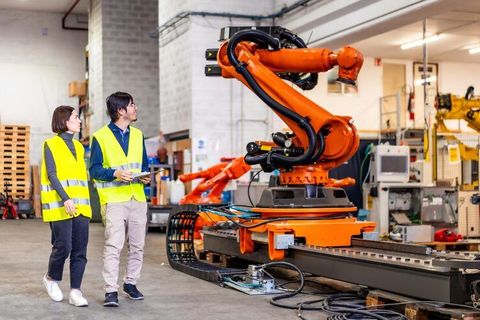
Industrial Robotics
Robots can perform repetitive handling, welding, assembly, inspection, and material movement tasks. Their use can also support consistent production processes where repetitive operations are involved.
Additive Manufacturing
Additive manufacturing creates parts by depositing material layer by layer. It is particularly useful for prototypes, complex geometries, customized components, and selected low-volume applications.
Machine Vision and Automated Inspection
Cameras and inspection systems can examine dimensions, surface conditions, markings, and assembly characteristics. Automated inspection can complement conventional measurement methods.
Industrial Internet of Things
Connected sensors can collect information from machines and production lines. Data can be used to monitor equipment conditions, production patterns, energy use, and process performance.
A simplified manufacturing data flow can be viewed as:
Design → Material Selection → Production → Inspection → Data Analysis → Quality Improvement
Recent Updates and Manufacturing Trends
The 2025–2026 period has brought significant attention to advanced manufacturing, domestic production, electronics, clean technology, and industrial technology in India.
In February 2025, the Union Budget announced the National Manufacturing Mission for small, medium, and large industries. Its stated focus areas include technology availability, quality products, MSME development, workforce readiness, and manufacturing competitiveness. The mission also includes clean-technology manufacturing areas such as solar photovoltaic cells, electric vehicle batteries, motors, electrolyzers, wind turbines, and grid-scale batteries.
During 2025, India continued expanding its Production Linked Incentive framework across 14 strategic sectors. Government data reported more than ₹2.16 lakh crore in cumulative investment under the schemes as of December 2025.
Electronics component manufacturing also received additional policy attention. The Electronics Components Manufacturing Scheme was approved in April 2025 with a ₹22,919 crore funding framework, focusing on strengthening domestic electronics component production and increasing domestic value addition.
In 2026, government reporting highlighted continued manufacturing activity across medium- and high-technology industries. A February 2026 government update reported manufacturing GVA growth of 7.72% in Q1 and 9.13% in Q2 of FY 2025–26, while medium- and high-technology industries accounted for 46.3% of manufacturing value added.
These developments point toward several continuing trends:
- Greater use of automation and digital production systems
- More attention to domestic component ecosystems
- Growth of electronics and advanced technology manufacturing
- Increased use of data-driven quality control
- Expansion of clean-technology manufacturing
- Greater integration with global manufacturing networks
Laws, Standards, and Policies Affecting Manufacturing in India
Industrial component manufacturing in India can be affected by product-specific standards, Quality Control Orders, environmental requirements, workplace rules, taxation frameworks, and sector-specific regulations.
The Bureau of Indian Standards explains that while standards are generally voluntary, the government can make compliance compulsory for particular products through Quality Control Orders. Products covered by such orders may require conformity with specified Indian Standards and applicable BIS certification requirements.
This is important for component manufacturers because the applicable requirements depend on the product category and intended application.
Recent Quality Control Orders illustrate how requirements can change. For example, the Stainless Steel Pipes and Tubes Quality Control Order, 2025 covered specified seamless and welded stainless-steel pipes and tubes, with implementation beginning in August 2025.
BIS also maintains information on upcoming Quality Control Orders. Its current listings include several products with implementation dates in October 2026, including specified pipe wrenches, spanners, and aluminium products.
Manufacturers should therefore check the latest applicable standard before producing or supplying a regulated component. Requirements can vary according to material, dimensions, application, sector, and product classification.
Tools and Resources for Industrial Component Manufacturing
Several categories of tools can help users understand, design, manufacture, and inspect industrial components.
Design and Engineering Tools
- CAD software for 2D and 3D component design
- Engineering simulation platforms
- Digital measurement and tolerance calculators
- Material-selection references
- Technical drawing templates
Production Planning Tools
- Production scheduling templates
- Process-flow diagrams
- Manufacturing resource planning systems
- Inventory tracking spreadsheets
- Machine-capacity calculators
Quality Tools
- Inspection checklists
- Statistical process control worksheets
- Dimensional measurement tools
- Root-cause analysis templates
- Calibration records
Learning Resources
- Engineering standards databases
- Manufacturing technology textbooks
- Technical training materials
- Industrial safety documentation
- Government manufacturing portals
- Standards and conformity-assessment guidance
A useful starting point is to identify the component's function, material, required dimensions, operating environment, applicable standard, manufacturing method, and inspection requirements.
Frequently Asked Questions
What is industrial component manufacturing?
Industrial component manufacturing is the production of individual parts used within machines, vehicles, equipment, structures, and larger industrial systems. It includes processes such as machining, casting, forging, forming, molding, fabrication, and additive manufacturing.
Which materials are commonly used?
Common materials include carbon steel, stainless steel, aluminium alloys, copper alloys, engineering plastics, composites, and specialized materials. Selection depends on strength, temperature, corrosion resistance, weight, electrical properties, and the component's intended application.
How does automation affect component manufacturing?
Automation can control repetitive production and inspection activities using CNC equipment, robotics, sensors, machine vision, and software. It can improve process consistency while also creating a need for suitable programming, maintenance, monitoring, and quality-control practices.
What is the role of quality control?
Quality control verifies that components meet defined specifications. Depending on the product, this may include dimensional inspection, material verification, surface inspection, functional testing, and documentation.
Are industrial components required to meet government standards?
Some are, while others may be governed primarily by industry specifications or contractual requirements. In India, certain products are covered by mandatory Quality Control Orders and BIS conformity requirements. The applicable regulation should be checked for the specific product category.
Conclusion
Industrial component manufacturing forms an important foundation for modern machinery, transportation, electronics, energy systems, and industrial equipment. The field is moving beyond conventional production toward connected machines, digital engineering, automated inspection, robotics, advanced materials, and data-based process control.