Industrial Welding Robots: Advanced Automation & AI Welding Technology
Industrial welding robots are automated robotic systems designed to perform welding operations with controlled movement and repeatable accuracy. They are commonly used for processes such as arc welding, spot welding, MIG welding, TIG welding, and other automated joining applications.
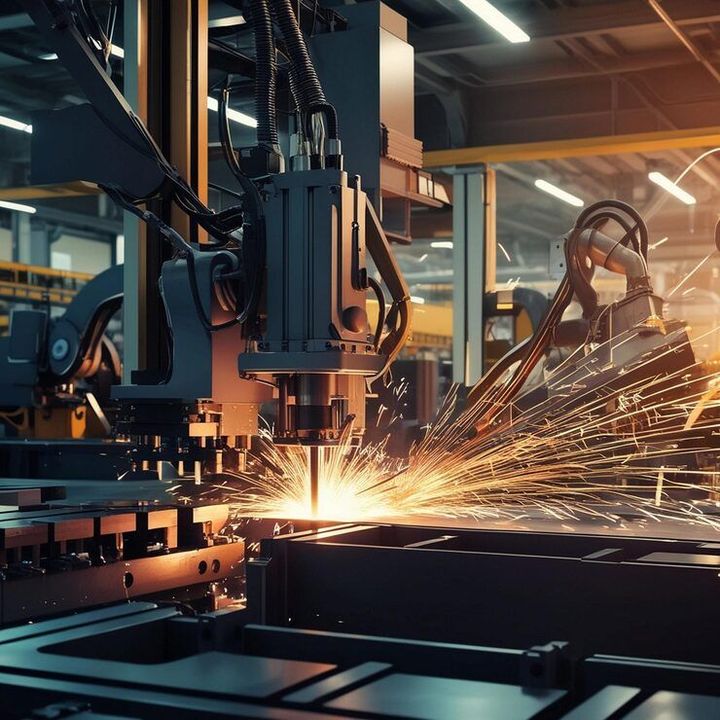
A typical robotic welding cell includes a robotic arm, welding torch, power source, positioner, fixtures, sensors, control software, and safety equipment. These components work together to move the welding torch along a programmed path while maintaining suitable welding parameters.
The technology exists because many manufacturing processes require repeated welds with consistent positioning and timing. Manual welding remains important for many applications, but repetitive production tasks can be difficult to maintain at the same level of consistency throughout long production cycles.
Modern industrial welding robots are becoming more intelligent. Traditional systems generally follow predefined instructions, while newer systems can use machine vision, sensors, artificial intelligence, and data analysis to respond to variations in workpieces and welding conditions.
This development is closely connected with Industry 4.0 and smart manufacturing. Instead of treating a robot as an isolated machine, manufacturers increasingly connect robotic welding cells with digital production systems for monitoring, quality control, data collection, and process optimization.
Why Industrial Welding Robots Matter Today
Industrial welding robots matter because manufacturers are looking for greater consistency, better production control, and improved workplace safety. Welding can involve heat, fumes, sparks, repetitive movements, and challenging working positions.
Automation can move workers away from some of the most repetitive or hazardous parts of the welding process while allowing people to focus on programming, inspection, setup, maintenance, and process management.
The technology affects several major industries, including:
- Automotive and vehicle manufacturing
- Construction equipment production
- Shipbuilding
- Heavy machinery manufacturing
- Metal fabrication
- Energy infrastructure
- Agricultural equipment
- Aerospace manufacturing
- Structural steel production
One important advantage is repeatability. Once a suitable program and process have been validated, a robot can reproduce the same movement pattern across many workpieces.
Robotic welding can also support predictable cycle planning. Sensors and digital monitoring systems can record information such as welding current, voltage, travel speed, temperature, and other process variables.
AI welding technology adds another layer of intelligence. Machine-learning models and computer-vision systems can analyze images, sensor signals, and process data to identify variations that may affect weld quality.
However, AI does not eliminate the need for human expertise. Welding procedures still require proper engineering, inspection, process qualification, safety controls, and trained personnel.
Main Types of Industrial Welding Robots
Industrial welding robots are available in different configurations depending on the application.
Articulated welding robots use multiple rotary joints to provide flexible movement around a workpiece. They are widely used for complex welding paths.
Spot welding robots are commonly associated with automotive manufacturing. They position electrodes at specific points to join metal components.
Arc welding robots use a welding torch to create continuous or controlled welds. They are suitable for many fabricated metal components.
Collaborative welding robots, often called cobots, are designed to work in environments where human interaction is part of the workflow. Appropriate risk assessment and protective measures are still essential.
Gantry and linear robotic systems use structured movement along one or more axes. They can be useful for large workpieces and long welding paths.
The appropriate configuration depends on material, joint design, workpiece dimensions, production volume, welding process, required accuracy, and workplace layout.
How AI Is Changing Robotic Welding
Artificial intelligence is becoming an important part of advanced robotic welding technology. The biggest change is the move from fixed automation toward adaptive automation.
Machine vision can help a robot identify the location and shape of a weld joint. Laser and optical sensors can support seam tracking, while other sensors can monitor welding conditions.
AI can analyze these signals and identify patterns associated with process variation. Depending on the system, this information can support adjustments to robot movement, welding parameters, or inspection procedures.
Recent research published in 2026 highlights the growing integration of sensors, machine learning, computer vision, and real-time process monitoring in intelligent robotic arc welding. These technologies are being studied for weld-seam recognition, defect detection, temperature monitoring, and adaptive control.
Vision-based autonomous welding has also received significant research attention. A September 2025 review identified weld identification, path generation, seam tracking, welding parameter planning, and quality control as important areas for advancing autonomous robotic welding.
AI can therefore support several stages of the welding workflow:
- Workpiece recognition
- Weld-seam identification
- Seam tracking
- Welding-path generation
- Process monitoring
- Defect detection
- Predictive equipment monitoring
- Digital quality documentation
These capabilities are particularly useful when manufacturers need greater flexibility than traditional fixed programming can provide.
Recent Developments in 2025 and 2026
The period from 2025 to 2026 has seen growing interest in intelligent and adaptive robotic welding.
In September 2025, research presented vision-based autonomous robotic arc welding as an important direction for improving robot adaptability. The work highlighted computer vision, seam tracking, path generation, and automated quality control.
In January 2026, industry discussions increasingly focused on adaptive welding, closed-loop control, connected production, and traceability. These approaches allow sensors and algorithms to monitor welding conditions and support adjustments when workpiece variations occur.
A March 2026 welding-industry review also identified robotic automation, digital quality control, advanced materials, and connected manufacturing as major technology trends. It noted that automation is increasingly changing welding-related responsibilities toward programming, quality assurance, system supervision, and advanced fabrication activities.
In April 2026, a comprehensive review of intelligent robotic arc welding examined sensor integration, AI, machine learning, real-time monitoring, and automated defect detection. The research emphasized the importance of combining sensing technologies with intelligent control systems.
These developments show that the direction of robotic welding is moving beyond simple repetitive motion. Future systems are increasingly expected to understand process conditions, respond to variation, and maintain digital records of production information.
Laws, Safety Standards, and Policies
Industrial welding robots are affected by workplace safety requirements, machinery regulations, electrical safety rules, welding standards, and robot-specific safety frameworks.
For manufacturers in India, industrial robot safety is particularly relevant when designing or operating automated welding cells. The Bureau of Indian Standards has developed Indian standards aligned with international robotics safety requirements. A BIS draft published in January 2024 addressed IS/ISO 10218 Part 1 for industrial robot safety and identified it as a revision of earlier Indian standards.
A safe robotic welding cell generally needs appropriate measures such as:
- Physical guarding where required
- Safety-rated access controls
- Emergency-stop systems
- Risk assessment
- Safe robot operating procedures
- Welding-fume controls
- Electrical protection
- Fire prevention measures
- Appropriate personal protective equipment
- Operator and maintenance training
Standards and regulatory requirements can differ by country and application. Manufacturers should therefore verify the latest applicable national requirements before commissioning an industrial robotic welding system.
Safety should not be treated as an optional feature. A robot capable of moving heavy equipment at high speed can create serious hazards if the work cell is poorly designed or incorrectly operated.
Tools and Resources for Robotic Welding
Several categories of digital and technical resources can help users understand, plan, and monitor robotic welding systems.
Robot simulation software can help engineers create virtual layouts, test movement paths, identify possible collisions, and estimate cycle behavior before physical deployment.
Welding parameter calculators can assist with basic calculations involving current, voltage, travel speed, heat input, and other process variables. Actual welding procedures should still follow qualified engineering requirements.
CAD and digital-twin platforms can represent workpieces, fixtures, robot movements, and production layouts in a digital environment.
Machine-vision tools can support weld-seam detection, workpiece recognition, dimensional inspection, and quality monitoring.
Robot programming environments allow engineers to create, test, modify, and manage robot movement programs.
Data dashboards can display production information such as cycle time, equipment status, welding parameters, alarms, and inspection results.
Safety assessment templates can help teams document hazards, protective measures, operating procedures, and maintenance requirements.
For learning, users can also consult welding technology textbooks, robotics training materials, industrial safety documentation, engineering standards, technical journals, and educational courses focused on automation and manufacturing.
Frequently Asked Questions
What is an industrial welding robot?
An industrial welding robot is an automated robotic system designed to perform welding operations along programmed or sensor-guided paths. It typically combines a robotic arm, welding equipment, controls, fixtures, and safety systems.
How does AI improve robotic welding?
AI can analyze information from cameras and other sensors to identify weld seams, detect process variations, recognize potential defects, and support adaptive control. Its effectiveness depends on data quality, system design, training, and appropriate validation.
Are welding robots suitable for every manufacturing application?
No. Robotic welding is most suitable when the workpiece, joint design, production process, and workspace can be reliably controlled. Highly variable parts or difficult access conditions may require additional sensing, flexible tooling, or manual processes.
Do industrial welding robots replace human expertise?
Not completely. Skilled personnel remain important for process engineering, programming, setup, inspection, maintenance, safety assessment, and troubleshooting. Automation generally changes how human expertise is applied rather than removing the need for it.
What is the future of AI welding technology?
The future is likely to involve greater use of machine vision, sensor fusion, closed-loop control, digital twins, automated inspection, predictive monitoring, and AI-assisted programming. Research is also exploring more flexible robotic systems for high-mix manufacturing.
Conclusion
Industrial welding robots are becoming an important part of modern manufacturing automation. Their ability to perform repeatable movements, maintain consistent process conditions, and work with digital monitoring systems makes them valuable for many industrial applications.