Industrial Motor Automation: Guide to Smart Manufacturing Technology
Industrial motor automation is the use of automated control technologies to manage electric motors used in manufacturing equipment and industrial processes. Motors are found in conveyors, pumps, compressors, fans, mixers, machine tools, material-handling equipment, and many other systems.
motor control often depends on basic switching, manual adjustments, or fixed operating conditions. Modern automation introduces programmable logic controllers (PLCs), variable frequency drives (VFDs), sensors, human-machine interfaces (HMIs), industrial networks, and monitoring software.
The main purpose is to coordinate motor operation with the wider production process. A motor can start, stop, accelerate, decelerate, or operate at a controlled speed according to signals from sensors and controllers.
A typical industrial motor automation system can include:
- Electric motors and motor starters
- Variable frequency drives
- Servo drives and servo motors
- PLC control systems
- Industrial sensors
- Human-machine interfaces
- Industrial communication networks
- Energy and power monitoring equipment
- Supervisory control and data acquisition systems
- Condition-monitoring technology
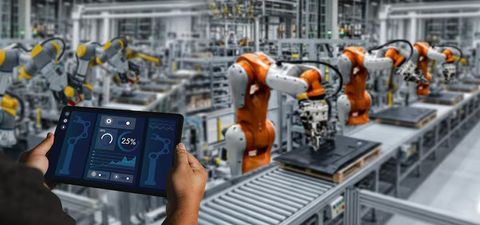
Smart manufacturing extends this approach by connecting equipment and operational data. Instead of controlling a motor without broader information, connected systems can collect operating conditions and use the information for monitoring, diagnostics, process optimization, and maintenance planning.
How Motor Automation Works
A basic automated motor system follows a control sequence.
A sensor measures a physical condition such as speed, pressure, temperature, position, flow, or vibration. The controller processes that information and compares it with programmed operating parameters.
The controller then sends instructions to a motor drive or control device. The drive adjusts the motor according to the required operating condition.
| Component | Main Function |
|---|---|
| Motor | Converts electrical energy into mechanical motion |
| VFD | Controls motor speed and operating characteristics |
| PLC | Executes programmed control logic |
| Sensor | Measures process or machine conditions |
| HMI | Provides an interface for operators |
| Industrial network | Transfers control and monitoring data |
| Monitoring software | Displays trends, alarms, and equipment information |
This architecture allows motor operation to become part of a coordinated industrial automation system rather than functioning as an isolated machine component.
Why Industrial Motor Automation Matters Today
Improving Process Control
Manufacturing processes often require consistent movement and controlled operating conditions. Automated motor control can help equipment maintain programmed speed, position, acceleration, and timing.
For example, a conveyor may need to maintain a specific speed while coordinating with packaging or inspection equipment. Automated control allows these functions to work together according to defined process parameters.
Supporting Energy Management
Electric motors can represent a significant portion of industrial electricity consumption. Motor automation can help organizations monitor operating patterns and avoid unnecessary operation.
Variable frequency drives are particularly relevant where motor speed does not always need to remain constant. Controlling speed according to process demand can change the motor's operating profile.
However, actual energy results depend on the motor, load, control strategy, operating schedule, and equipment design. Automation should therefore be evaluated using measured operating data rather than assumed savings.
Improving Equipment Visibility
Connected motor systems can provide information about:
- Running hours
- Motor speed
- Current and voltage
- Temperature
- Vibration
- Fault conditions
- Start and stop cycles
- Energy consumption
- Drive alarms
This information can help technical teams identify unusual operating conditions before they develop into larger equipment problems.
Supporting Predictive Maintenance
Condition monitoring is becoming increasingly important in smart manufacturing. Sensors can continuously observe equipment characteristics and identify changes from normal operating patterns.
For example, increasing vibration may indicate a developing mechanical issue. Rising temperature may indicate abnormal loading, ventilation problems, or another condition requiring investigation.
Predictive maintenance does not guarantee that equipment failures will be prevented. Its value comes from providing additional information that can support maintenance decisions.
Recent Developments in Motor Automation
Connected Industrial Equipment
During 2025 and 2026, industrial automation continued moving toward greater connectivity between operational technology and information technology. Modern manufacturing architectures increasingly combine PLCs, industrial networks, sensors, edge computing, analytics, and centralized monitoring.
This creates more opportunities for data-driven motor control but also increases the importance of cybersecurity.
Manufacturing Cybersecurity
In September 2025, the U.S. National Institute of Standards and Technology published an initial public draft of its Cybersecurity Framework 2.0 Manufacturing Profile. The draft aligned manufacturing guidance with CSF 2.0 and added areas including supply-chain risk management, platform security, and technology infrastructure resilience.
In May 2026, NIST also published an initial public draft focused on responding to and recovering from cyberattacks in manufacturing industrial control system environments. The guidance addresses incident response and operational recovery for connected manufacturing systems.
These developments are relevant to motor automation because connected drives, PLCs, sensors, and industrial networks can become part of a larger operational technology environment.
Greater Use of Data and Diagnostics
Industrial automation is also moving beyond simple start-and-stop control. Modern systems can combine motor information with production data, machine conditions, and historical trends.
This supports applications such as:
- Motor condition monitoring
- Drive diagnostics
- Energy monitoring
- Production analytics
- Remote equipment visibility
- Alarm management
- Digital maintenance records
The growing use of industrial data means that automation engineers increasingly need to consider both control performance and data security.
Laws, Standards, and Policies
European Machinery Requirements
Regulatory requirements vary according to the country, machine type, industry, and intended market. Manufacturers and integrators should therefore identify the rules that apply to their specific equipment.
In the European Union, Regulation (EU) 2023/1230 establishes machinery safety requirements and is scheduled to apply from 20 January 2027. Certain provisions have earlier application dates.
For automated machinery, safety considerations can include control systems, protective functions, risk assessment, technical documentation, and conformity requirements.
Cybersecurity Considerations
In the United States, NIST provides voluntary cybersecurity guidance for manufacturing environments. Its manufacturing profile addresses industrial control systems, operational technology, network security, risk management, and related controls.
NIST's manufacturing cybersecurity guidance is not a universal legal requirement. It provides a risk-based framework that organizations can use alongside applicable laws, regulations, contractual requirements, and industry standards.
Electrical and Machinery Safety
Motor automation projects can also involve electrical safety, machine guarding, emergency stopping, control-system design, electromagnetic compatibility, and equipment documentation.
Because requirements differ between jurisdictions, project teams should verify applicable national and regional standards before commissioning automated machinery.
Tools and Resources for Motor Automation
Motor Sizing Calculators
Motor sizing tools can help estimate required power, torque, speed, and operating characteristics. They are useful during preliminary system design, although final selection should consider the complete machine and load profile.
Drive Configuration Tools
Variable frequency drive configuration software can assist with parameter setup, diagnostics, motor identification, and monitoring.
PLC Programming Platforms
PLC development environments are used to create ladder logic, structured text, function blocks, and other control programs.
HMI Design Tools
HMI platforms allow operators to view motor status, alarms, trends, process values, and operating parameters.
Energy Monitoring Tools
Electrical monitoring instruments and energy-analysis platforms can track voltage, current, power, power factor, and consumption patterns.
Condition-Monitoring Tools
Vibration meters, thermal measurement devices, current monitoring equipment, and sensor platforms can support motor health analysis.
Industrial Network Diagnostics
Network diagnostic tools can help identify communication problems involving industrial Ethernet, fieldbus systems, and other automation networks.
Frequently Asked Questions
What is industrial motor automation?
Industrial motor automation is the automated control and monitoring of electric motors used in industrial equipment. It commonly combines motors, drives, sensors, PLCs, HMIs, and communication networks.
What is the role of a VFD in motor automation?
A variable frequency drive controls the electrical frequency and voltage supplied to an applicable motor, allowing controlled motor speed and operation. The correct configuration depends on the motor, load, drive, and application.
How does motor automation support smart manufacturing?
Motor automation generates operational information that can be integrated with wider manufacturing systems. This can support monitoring, diagnostics, production visibility, energy analysis, and maintenance planning.
Can motor automation reduce energy consumption?
It can contribute to improved energy management in suitable applications, particularly where motor speed can be matched to changing process demand. Actual results depend on the equipment and operating conditions.
Is cybersecurity important for automated motor systems?
Yes. Connected PLCs, drives, sensors, HMIs, and industrial networks can form part of an operational technology environment. Access control, network segmentation, authentication, monitoring, and risk assessment can therefore be important considerations. NIST provides manufacturing-focused cybersecurity guidance for this area.
Conclusion
Industrial motor automation is an important part of modern smart manufacturing. By combining electric motors with drives, sensors, PLCs, HMIs, communication networks, and monitoring technologies, manufacturers can create more connected and controllable production systems.